

Over a year ago, I discovered that most nutrients from grains are missing in the flour we buy at the store. This processed and refined flour that sits on the shelves is radically different than the Fresh Milled Flour they used in generations past.
It also suggested that those who struggle with gluten may handle freshly milled flour better because it’s fresh, contains significantly more nutrients, and doesn’t have toxic chemicals sprayed on it like conventional wheat in America.
Fresh Milled Flour Experiment
Our family has been gluten-free off-and-on for years, typically feeling healthier without gluten. But I was struck by how many times the Bible mentions Jesus breaking and sharing bread. People ate bread as a staple for years, yet gluten-free eating is so common today. I began to wonder if perhaps bread actually is good for you–if it’s made right.
So I decided to experiment…

Since grinding my fresh flour at home, I’ve barely bought store-bought flour for two main reasons:
- It’s so much more nutritious because it’s fresh and it’s made from the whole grain.
- It tastes amazing! It has more flavor like real, wholesome, yummy food should.
If you’re curious about milling your own fresh flour, this article answers some of the most frequently asked questions I’ve gotten about how to get started with Fresh Milled Flour (FMF) at home.
What is FMF?
Fresh Milled Flour is commonly shortened to FMF.
Fresh Milled Flour is a grain that has recently been milled.

Why Switch to Fresh Milled Flour?
After avoiding gluten for years, I was shocked to learn whole grain wheat (the kernel you pick from the farmer’s field) contains 40 of the 44 essential nutrients that the human body needs to thrive. It’s only missing vitamin C, vitamin A, vitamin B12, and iodine.
You see, whole grains have 3 basic parts:
- Bran
- Germ
- Endosperm
The bran is high in fiber, and it has a good amount of proteins and enzymes that help with digestion.
The germ is the smallest part of the kernel, but it contains the highest density of nutrients–mostly fatty acids and a lot of vitamin E.
The endosperm is the largest part of the kernel. It’s primarily starch, and it serves as the food for the plant. This is the only part you get with commercial white flour.
With fresh-milled flour, the bran and germ of the grain are not removed during processing, making fresh-milled flour a good source of fiber, vitamins, and minerals, such as iron, magnesium, and potassium.
The nutrients are the main reason I switched. However, the taste and nutrient combination keeps me coming back to bake more and more!
What Mill Do You Use?
I use the NutriMill Classic Electric Grain Mill. It can grind a lot of fresh flour quickly, and it’s much easier than hand-grinding.
I like the look of the beautiful wooden NutriMill Harvest, but this white mill fit within our budget and had many good reviews.
Where Did You Get the Mill?
I ordered my mill on Amazon. Easy peasy.
Since fresh-milled flour has grown in popularity, these mills seem to go in and out of stock frequently, so check back often if it’s currently out of stock.
Alternatively, the NutriMill Harvest and NutriMill Impact Compact Mill seem to be in stock more often.
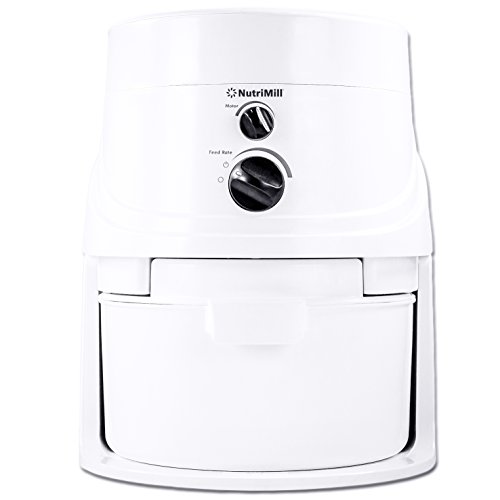
Grind your own fresh flour packed with nutrients with this electric grain mill.
Mills 20 cups of fresh flour in 5 minutes.

Another excellent home mill option. Many appreciate that it's easy to use and clean, while looking nice enough to leave on the counter.

NutriMill's least expensive mill can hold up to 12 cups of fresh-milled flour.
Where Do You Get the Wheat Berries and Other Grains?
I’ve gotten wheat and other grain berries from a few places so far:
- a local Amish grocery store
- Ancient Grains ancientgrains.com
- Azure Standard azurestandard.com **My referral code is: ValBreit1
- Vitacost vitacost.com
From Azure Standard, I ordered a 25-pound bag of each:
- Organic Soft White Wheat Berries
- Organic Hard Red Wheat Berries
- Organic Khorasan (also called Kamut in some recipes)
- Organic Einkorn Grain
Azure is a health food co-op with local community drop locations. I use the drop in Oconomowoc, Wisconsin. (I get Azure points for bringing new friends, so you can use the code ValBreit1 if you’d like to join Azure and do something kind. I appreciate it!)

From Ancient Grains, I ordered:
At the Amish grocery store, I bought small bags of:
- Rye Berries
- Whole Oat Groats
- Spelt Berries (These actually had bugs in them, so they became chicken food. Now I’m leery of buying off shelves at stores and only order from reputable companies online. Lesson learned.)
From Vitacost, I bought a small box of Organic Einkorn Wheat Berries to test. Then I ordered a larger amount from Azure Standard.
How Do You Store Your Grains?
I store most grains in Food Grade 5-gallon buckets.
**Each 25-pound bag of grain fits in a 5-gallon bucket.

I use and highly recommend the Gamma Seal lids that twist on and off easily because they’re airtight and they’re not a pain to get on and off.
I found Gamma Seal lids and buckets at Menards; I’ve also gotten food-grade buckets at Tractor Supply Store. You can also find them on Azure or Amazon.

5 Gallon Plastic Bucket, Food Grade, with Blue Screw on Lid (Pack of 3). Made in the USA
You can also store some grains in smaller quantities in glass half-gallon mason jars, as seen in the jar of spelt below.

All the grains are stored in a cool, dark room in our basement, so they should last several years.
I would avoid storing your grains in sunny or warm locations.
How Long Do The Grains Last?
Years, even decades. Some say they’ll keep indefinitely when stored properly.
Keep the berries cool and dry. If you notice a change in color, texture, or smell, they’ve probably spoiled, but store them properly, and they should last a very long time.
Which Grains Do You Like Best?
That is a hard question! I use them all for different reasons and I love having a variety of grains.
When I’m replacing “all purpose flour,” in a recipe that wasn’t created using fresh-milled flour, I typically use a blend using an equal amount (1/3 each) of three grains:
- Hard white wheat
- Soft white wheat
- Kamut or khorasan
I got this recipe from this FMF Cookbook, and it’s worked well, especially when I measure in grams using my digital scale.
For typical loaves of bread, either a boule or loaf of sandwich bread, I use Hard White and Hard Red Wheat most. Sometimes I’ll add a little Kamut too.

The buns I frequently take to family gatherings and pot lucks use Hard Red Wheat.

For quick breads, like zucchini or banana bread, I often use a combination of Soft White Wheat and Spelt. I recently learned Einkorn is a great grain for quick breads too.
I’ve been surprised to like Spelt because I didn’t even know what it was before I got into fresh-milled flour. We double the Spelt Waffle recipe from this FMF Cookbook for our Waffle Wednesday dinners most weeks, and they’re delicious.
Here is a picture of spelt berries in a jar before grinding and the fresh milled flour after milling the berries.

And here’s the waffles mid-meal. We make these almost every week. Our whole family enjoys them, and if there are any leftovers, they’re easy to warm up in the toaster or air fryer.

I use Hard White Wheat and Kamut for the sandwich bread we all really like. I use a recipe from the same Fresh Milled Flour Cookbook.
Below is a picture of hard white wheat berries before milling.

And below is what whole Khorasan wheat looks like before milling them into flour, aka “kamut.”

And here’s a (non-professional) picture of some of my first sandwich breads. It’s super soft and delicious.

I used a combination of Hard White Wheat and Hard Red Wheat for cinnamon rolls, but I’m guessing they’d be good with just hard white too.
Here’s a picture of our fresh milled flour cinnamon rolls before baking. They were a delicious Christmas treat!


I’ve liked Soft White Wheat for most of my cookies, brownies, and pancakes.

After You Mill Flour, How Long Does It Stay Fresh?
The freshly milled flour is best used right away because it contains the most nutrients and has the best flavor.
My understanding is that if you use the flour within 3 days, it will still contain most of its nutrients.
After three days, the nutrients and flavor decline. Due to the natural oils in the bran and germ, it can oxidize quickly and get rancid. (This is why storebought flour can sit for years because it does not have the bran or germ.)
After Milling, How Do You Store Your Flour?
If I mill flour and do not use it immediately, I will store it in an airtight container in the refrigerator for up to three days.
If I mill a little extra, I’ll store it in a freezer baggie in the freezer for longer storage. I usually use this extra flour for dusting, or if I end up a little short while making a recipe for some reason.
Do You Use Sourdough or Yeast?
Both! They both work well, and both taste fantastic.
If you’re used to baking sourdough boules with the fluffy store-bought flour, you probably will not get quite as much of a rise with fresh milled flour, but trust me, it still turns out nutritious and delicious.
I have not yet converted my sourdough starter to fresh-milled flour, but I know you can. It’s on my list of things to try.
Which Yeast Do You Use?
I use saf-instant yeast. I got the one-pound bag from Amazon, and it will last a long time!

I store it in a bag in the freezer. It may feel like a hard block when you receive it, but don’t worry. The yeast is soft and able to scoop easily as soon as you cut open the package.
What Recipe Books Do You Use?
I’ve used two books primarily for recipes:
- Fresh Milled Flour Cookbook by Kara Britch of Grains in Small Places
- The Essential Home-Ground Flour Book by Sue Becker

I love using recipes that were created with fresh-milled flour and relied mostly on those recipes at first, until I got more familiar with fresh-milled flour.
However, you can use non-fresh milled flour recipes and convert them.
Three tips I’ve learned about working with fresh-milled flour are:
- Recipes that measure with weight in grams convert best
- It can be beneficial to let the dough or pancake mix or whatever you’re making sit for 10+ minutes because it takes longer for the whole grains to absorb the liquids.
- Einkorn is a totally different grain. I’m new to working with this grain and will be sticking with Einkorn-specific recipes until I get more practice.
Besides a Mill and Berries, Are There Any Other Supplies You Need?
There are a lot of things that can be handy, however, only two inexpensive tools are really necessary to start your fresh-milled flour journey.
- A kitchen scale is important. I’ve had the most success using recipes that measure ingredients in grams.
- A digital thermometer is very useful. Many recipes indicate what the internal temperature should be, which is great because sometimes the outside looks brown and done, but the inside is still gooey.


There are many tools that you can add or upgrade, but I don’t think anything else is necessary to get started.

Wishing you the best on your fresh-milled flour journey! I hope your family loves it as much as we have.
This post was originally published in January 2025. It was updated January 2026.
Recent Posts
Sending your child with food allergies to school or daycare can cause a lot of anxiety for parents. So what are some tips for preventing reactions and keeping your child safe when they're not at...
What to Know about BOROUX Water Filters Before You Buy(similar to Berkey)
By now, you've probably realized Berkey water filters are no longer available. Hence, this article has been updated to reflect BOROUX water filters, which are just as good--if not better--than...